12 December 2016

St Agnes September 24th to 22nd October 2016

It had been a good spell on St Agnes before we got there and even before we reached Smugglers' Cottage for our sixth consecutive autumn visit, we had caught up with a very obliging Red-breasted Flycatcher at the Bulb Dump and the Lesser Yellowlegs on the Big Pool, both found by Graham Gordon in the preceding days and there had been another R B Fly at Covean earlier. The Lesser Yellowlegs hung around for a week or so and showed unbelievably well, often joined by a Little Stint or Curlew Sandpiper and sometimes both.

Lesser Yellowlegs
The first week seemed likely to be quiet in terms of friends and birders, most people not appearing till October. However we were determined to pick up something good and we didn't have to wait long. We stopped at The Parsonage, hot and sweaty, late morning and Kathy picked up a Pied Flycatcher in the Elms which quickly disappeared. I sat on the school steps and scanned the Elm canopy. I focused on a movement and caught a largish passerine from below, looking off-white from my angle - and then I saw a greenish shoulder and just knew, instantly, that it was something good. A sudden view of a stonking supercilium and head shape and pattern and I called out to Kathy "Red-eyed Vireo!" and she got on to it pretty quickly and the important features were all confirmed in a minute or two. Strange how hard it is to measure time passing in these situations. I texted Dave Grundy and Graham Gordon and in a few minutes Graham and Rob Stonehouse appeared. Thankfully, the bird showed almost immediately, accompanied in to Graham's pishing by another bird which also flew off with it. None of us got onto this other similarly-sized bird but we did speculate that there were perhaps two Vireos present. When only a single bird was seen through the day the idea withered away and it took a pile of St Mary's birders stationed along the lane to be able to confirm the truth of it the next day. The weather closed in that morning forcing both to forage lower and give excellent view in company, both in the Elms and the pittosporum in the Lighthouse garden. The dates were, strangely, the same as for last year's bird found by Bob Dawson 25th September to the 2nd October. But what a great start to the trip. Magic!


Footman sp caterpillars were popular
We found a Red-backed Flycatcher, viewable from the coast path at Covean, next day presumably the same as had been seen not too far away in the Covean Sycamores the day before. Nevertheless it was all going rather well. A Tree Pipit was in the field below Smugglers, and there were sightings of one or two there for weeks to come. A Wryneck had been reported at Browarth even before we arrived but was really elusive, then on the 27th, one popped up on to the gate at the end of Barnaby Lane as we looked for a Quail which had been seen at the near end of Wingletang and we bumped into another on Gugh where a third was found by Graham I think. At the same time Kevin Button had bumped into a juvenile Red- Backed Shrike which we couldn't find at first, when we tried later we found it had moved to show really well near the Cafe.

Wryneck Kalmay Point

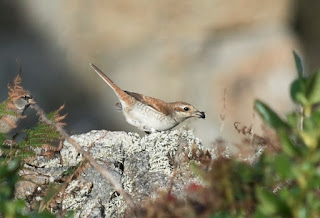
Red-backed Shrike above Santa Warner's Cove


The 4th of October was a bit special. More of the Crew had arrived by now and it became clear by mid-morning that birds were arriving and there was a real buzz about. The first Yellow-browed had been at The Parsonage the day before and more arrivedon the 4th along with a range of common migrants. Paul Wright found a new Red-breasted Flycatcher along with Yellow-broweds and Firecrest along New Lane. We picked up a couple of Ring Ouzels on Gugh but there were no rarities even though it felt like a great day.

Reed Warbler New Lane

Firecrest New Lane
A first winter Caspian Gull was found out on the Browarth rocks by Jamie Partridge, something very special as it turned out - a first for Scilly no less with a good suite of accompanying photos. Brilliant find.

Numbers of Yellow-broweds reached maybe 15 the next day and was at a similar high level through the next couple of weeks, definitely a record year. There was a briefly seen Barred Warbler seen near the Nag's Head where an incredibly tame Lapland Bunting showed well before moving to the Bulb Dump in later days.

Yellow-browed Warbler The Lighthouse
Lapland Bunting The Nag's Head


A Little Bunting was picked up by Paul Wright as it moved from Browarth on to Porth killier and beyond. Found in the end field on Browarth the next morning by David Bradshaw, it stuck around a few days to be enjoyed by all.

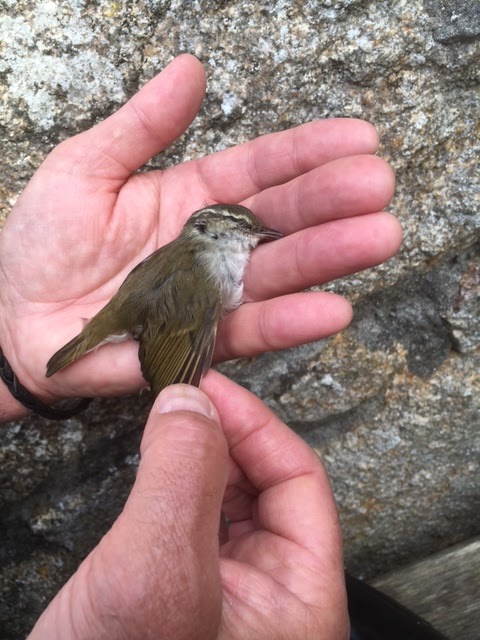
The bird of the trip, sort of, was found dead by Fran and Carol Hicks on 21st October, having collided with the conservatory at The Lighthouse. Thought, at first, to be a Yellow-browed it was soon recognised as one of the Arctic Warbler complex and finally as either Pale-legged or Sakhalin Leaf Warbler, a first for Britain if identified specifically on DNA evidence. If only it had just been stunned.

Pale-legged or Sakhalin Leaf Warbler in my hand if not in the bag!

The long 1st pp can be seen if not the dark crown


A great deal of the day was saved, however, when Lee Amery found a Red-flanked Bluetail in Chapel Fields. They may be about to lose their national rarity status but they are still magnificent finds. And what a rush of a day! However it is remembered by all those there it will certainly be as a big big day. We spent a month on St Agnes in all and our appetite for the Island remains undiminished. Next year it's five weeks and we can't wait to see the familiar places and the familiar, really good friends.

21 September 2016

Exploring Papa Westray - September 2016

After visiting Fair Isle last year we were keen to return to the Northern Isles but wanted to try something different. A conversation with David Douglas on St Agnes led us to want to try Papa Westray in Orkney. Having decided to go we must have been the only people a bit equivocal about the Chestnut Bunting found there subsequently - it was on the map now. Well done Julian Branscombe though, a great find by a really nice bloke.


The Wicks (North and South) were great for waders or maybe the American term Shorebirds works better here because the Island is full of waders but the biggest number inhabit the grasslands mainly - Curlew, the odd Whimbrel, Barwits, Lapwings, Golden Plover and zillions of Snipe. They were everywhere, on walls on roads in the morning - everywhere. We love Snipe so we were happy. Meanwhile back on the beaches it was Redshank, Sanderling and Dunlin mainly, Constantly moving with a backdrop of Seals and Eider.


The Fulmars were ever present and really close.


We visited the Holm of Papa, a small island off the east coast of Papay, it has two famous Neolithic sites, one of which was a burial chamber 70 feet long inside with side chambers for bodies. One of many amazing Orkney historical sites. One of the highlights of the whole trip occurred when a pod of 10 or so adult Risso's Dolphins appeared close in to the Holm and gave an amazing display. It was pretty memorable, we've seen Risso's well before but never so well as this.


 A couple of Purple Sandpipers were also present on the Holm, a hint of hundreds to come for the winter here.

Swallows were ever present, the last brood just fledging as we were on the Island. Twite were another breeding resident but sometimes needed a little bit of sorting out with large numbers of young Linnets knocking about.


The first Chaffinch of the autumn, there were a dozen or so around before we left.


North Wick here on a sunny day and the North-west on an equally sunny day with a swell rolling in.


There were still lots of Bonxies around, hanging about on the heather and out to sea. Just a few Arctic Skuas though, and lots of Fulmars. Three Red-breasted Mergansers joined the Eider for a day or two.


Wheatears were ever present, bouncing along everywhere every day. Maybe a hundred or so daily, many big, brightly-coloured Greenland and Iceland type birds. House Sparrows and Starlings too along the beaches and masses of the latter feeding on the kelp.


Holland Farm is like the cultural centre of the Island, amazing buildings and artifacts, all shown off, happily, by Neil Rendall the owner. It's also the best place on the Island to find a sheltering passerine migrant (along with the school). A few Pied Flycatchers, and Warblers were seen here but nothing better this timeunfortunately. We had a few near misses on our trip, a probable Buff-breasted Sandpiper disappeared before we could get closer and we missed a Juvenile Sabine's Gull, found by Julian down at the New pier by ten minutes. But such is life.


Out at the North end of the island we had some good birds. A Short-eared Owl came in-off the sea just in front of us one lunchtime and Kathy had what seems certainly to be a Rustic Bunting with the Mipits there. I missed it by seconds unfortunately. In some ways the story of the trip was Lapland Buntings. There was  a bit (or a lot) of an invasion and we got more than our fair share with 50+ some days. They provided good chances for photography.


So will we be back? Yes almost certainly, next year.


It's a lovely Island, very friendly and very attractive, most people stay one or two nights but we felt two weeks was much better. It gave us a chance of some good birds (though we hit a thin period generally) and allowed us to be a part of the Island for a bit. Timing is the thing. just when is best so that it fits in with other commitments like St Agnes - which is where we are heading off to next.