A beautiful May day today, bright sunshine and very little wind - superb. But quiet birdwise until Kathy and I were up on the shoulder of Carn Llidi and I heard a single call; immediately recognisable as a Bee-eater. I know the call as well as any bird call since they are always around our cave house in Spain (named by us 'Cueva Abejaruco' - Bee-eater Cave). Then the panic set in - I know very well the call carries a long way, they can be further off than you imagine and difficult to pick out. Kathy to the rescue! She drew my attention to three birds about 300 metres away and not much above our elevated position. Two of them were indeed Bee-eaters and the third something smaller. I picked out the distinctive shape and the bronze and yellow upperparts along with strong, curved bill. There were a couple more calls and Kathy called out that one was above our heads, and indeed it was, a lot closer and showing the blue underparts and ultra distinctive shape; all angles and sharp edges. They were moving quickly through, heading towards the coast and were soon out of view. We had definitely had three birds but, truth to tell, we hadn't had time to scan properly and there could actually have been a couple more. We trotted back to the top of the ridge and scanned the coast at the low gap called The Gesail, which is a good place to see moving Hirundines and the fields at Trfelli to the north-west where Hirundines etc often gather but no luck. And that was it! No time for photos - a brief but very satisfying experience.
17 May 2014

14 May 2014
Tundra/Arctic Ringed Plover
The northern race of Ringed Plover (Tundra or Arctic Ringed Plover) has been recorded at many sites in Britain, sometimes in considerable numbers such as the 500 recently at Breydon Water in Norfolk. My own experience of them comes from birds seen in Norfolk in the '90's where we considered them to be regular if scarce migrants (Google 'Tundra Ringed Plover' for records). The problem with'psamamiscus' identification is that there isn't a nice neat cut off between this race and the familiar 'hiaticula'but a clinal change with intergrades between the two. However, a combination of appearance, feather wear and 'jizz' should nail most individuals, especially when the two races are present allowing for a comparison.
As well as being smaller and darker than 'normal' Ringed Plover, they are quicker in movement, giving the impression of a chick or maybe a Kentish Plover as they dash about. They can be really quite distinct, especially if compared to a lumbering, pale 'hiaticula' Ringed Plover.
Additionally, Tundra Ringed Plover has a different moult pattern to 'hiaticula'; unlike nominate birds they undergo a complete moult on wintering grounds - so fresh flight feathers in spring can be a helpful indication of 'psamamiscus' and worth looking for if you have an interesting Ringed Plover.
My interest in this form of Ringed Plover as a Pembs bird goes back about ten years to a record of three of them (with a 'hiaticula'bird for a neat contrast) on the beach at Fishguard. I think it was 2002. I sent the record in for the Report at the time but they 'disappeared'. (Graham Rees has kindly recovered this record it was actually two birds on 19th January 2013). Tundra Ringed Plovers can and do occur here in Pembs, probably regularly. The bird below was present at Fishguard today, found by Adrian Rogers, and being extremely confiding like many high arctic birds can be. The freshness of the wing feathers, apparent size and colour make it seem pretty convincing to me. (all photos Adrian Rogers).


01 May 2014
Eastern Subalpine Warbler at St Davids Head
I was working on Skokholm on 13th April when I got a call from Ken Thomas, a long-time visiting birder from Neath, to say he had found a Subalpine Warbler out at the Head. Tragically (for me) I was stuck, not due to leave for another day so I contacted local birders to pass on the information and left it at that except to put a belated note and grid reference on the Pembs Blog when I reached the mainland. I also had a look around the area Ken specified as soon as I could but no luck. I did try to contact Ken again but failed. I spoke to him again several days later and he told me he had taken some photos and we made vague arrangements to meet up which never came to fruition and it wasn't until I bumped into Ken and wife Ann at the Head again that we spoke some more. I asked a bunch of questions and ran through some features differentiating Eastern Subalp from Western. I must have hit a chord because Ken sent me a text after looking at the pics again and then dropped by the house with his camera. I wasn't at all surprised to see what looked like a pretty good candidate for an adult male Eastern Subalpine Warbler. Incidentally, there was another Eastern bird reported from Shetland around that time as I recall.
These are all Ken's photos, I've cropped, slightly adjusted exposure and sharpened them a little but nothing else.
 |
| Photo 1 |
 |
| Photo 2 |
 |
| Photo 3 |
 |
| Photo 4 |
 |
| Photo 5 |
 |
| Photo 6 |
The first thing that struck me was the intensely coloured dark purply reddish throat, sharply demarcated from the rest of the underparts. The tone is a kind of brown ochre red rather than orangy/pink as might be expected for Western. Also in Western the strong colour should extend onto the flanks and contrast with the pale belly. In this bird the flanks are pale, apart from a very few streaks on the upper flank/breast and, as far as I can tell, concolourous with the rest of the underparts. Photos 2, 5 and 6 leave no doubt about how well marked the sub-moustachial stripe is. It's pretty stonking, another good feature for Eastern.
I think the bird is an adult rather than 2nd cal yr since the orbtal ring is strongly coloured orangy-red around a darker iris. Given this then the wing coverts, secondaries and tertials might be expected to be warmer brown in Western which is also darker blue-grey on back/mantle/head than Eastern, which is supposed to be a paler bird re the upperparts generally and this bird is quite a pale blue-grey with rather grey-brown flight feathers, the head appears darker than back and mantle at times, (though a caution that this is based solely on the photos and, it seems to me, photos can sometimes be problematic for judging subtle colour tones).
A recent paper by Lars Svensson (British Birds Nov 2013) set out new identification criteria re the pattern of T5 which is unfortunately no use using the photos we have here. It also suggested a three way split into three species Western, Eastern and Moltoni's including a re-ordering of scientific names.
At present BBRC examines records of Eastern Subalpine Warbler, there having been 43 accepted records to the end of 2013. There has been one previous accepted record in Pembrokeshire, on Ramsey in May 1993.
At present BBRC examines records of Eastern Subalpine Warbler, there having been 43 accepted records to the end of 2013. There has been one previous accepted record in Pembrokeshire, on Ramsey in May 1993.
17 March 2014
A Scandinavian Rock Pipit at The Head
March would be the peak time for picking up spring Littoralis back when I was birding at Sheringham in Norfolk and so maybe today's bird at St Davids Head should be no surprise. I wonder just how many are lurking in Pembs through the winter and how many go through on passage. For myself I'm thinking they are regular migrants though I do remember how variable numbers were on the east coast from one spring to the next.
Today's bird showed a faint pink wash to the throat sides at some angles and a kind of vinous tinge to the malar region so a bird in summer plumage following body moult but not the brightest by a distance. The supercilium was particularly striking, especially in front of the eye which is unusual I think. I'd expect it to start just before the eye and be boldest over it. The underparts were fairly pale and boldly streaked brownish, less grey in both regards to Petrosus. The outer tail feathers were very clean white for the distal third. The head, back and mantle were quite grey, lacking strong olive tones and contrasting with the browner (unmoulted?) wing feathers. The legs sometimes appeared dark but often more pink, as can be seen in the photos. How characteristic this is of Littoralis I'm not sure but it seems fairly consistent in my recent experience.


03 March 2014
North-east Granada again
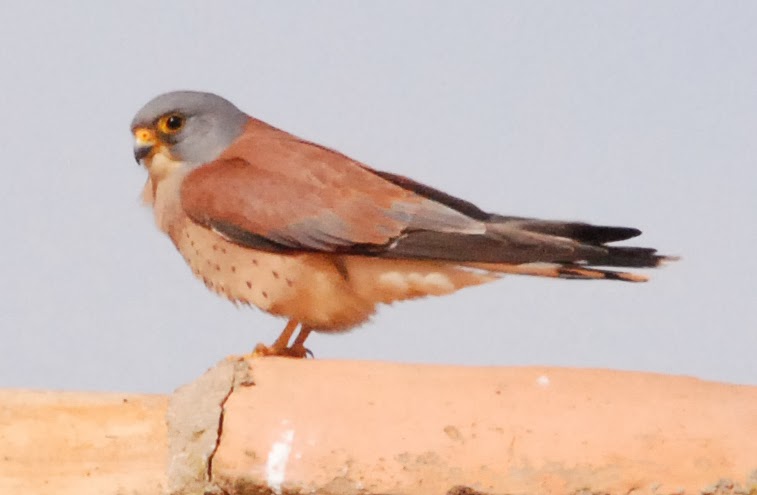
A quick visit for Kathy and I to the Cave in Galera and a quick photo diary of the area in February. Despite multiple computer failures, I've managed to get a post together for a largely unwatched area at a quiet time of year. Nice to see the odd summer migrants arriving - the Lesser Kestrels are back in force in my favourite deserted village out on the plain, breeding behaviour already evident. Nice to see the Almond trees coming into blossom. And the sun was great!


Skiing in the Sierra Nevada was a first (of many, hopefully), the snow conditions were brilliant and we had three gorgeous Alpine Accentors sharing our lunch - forgotten how good they are - bold and subtle-looking at the same time. Naturally no camera with us as they came to within a few feet.
The Iberian Shrike was singing at the Hoya de Baza, a once brilliant area being 'improved' (or in plain English - destroyed) bit by bit, a little more each year. The list of things we've seen in this tiny remnant is amazing but it's almost all gone now.

Rock Buntings and Rock Sparrows are really common around the Cave, the Rock Sparrows are breeding already.


Much of the agriculture in the area is small scale, though it's pretty industrial on the plains, often not very concerned with Health and Safety.


The area around the Sierra Maria is really varied and accessible. The woodland birds are generally very easy to see, though the Woodlarks, singing on the ridges, proved difficult to photograph.


Lots of Red Squirrels in the pine woods. Foxes are common too and some look very like our own. Others in places like Eagle Owl Valley look slim and long-eared, a bit like Jackals.

Golden Eagles aren't common, Short-toed and Booted Eagles are the commonest eagle species, though none of those were about in February.

Cirl Buntings are less common than Rock Buntings but share the same habitat, being found high up in the sierras as well as in the valleys.

Skiing in the Sierra Nevada was a first (of many, hopefully), the snow conditions were brilliant and we had three gorgeous Alpine Accentors sharing our lunch - forgotten how good they are - bold and subtle-looking at the same time. Naturally no camera with us as they came to within a few feet.
 |
| The Sierra Nevada from the Sierra de Baza |
Rock Buntings and Rock Sparrows are really common around the Cave, the Rock Sparrows are breeding already.
Much of the agriculture in the area is small scale, though it's pretty industrial on the plains, often not very concerned with Health and Safety.
The area around the Sierra Maria is really varied and accessible. The woodland birds are generally very easy to see, though the Woodlarks, singing on the ridges, proved difficult to photograph.
Lots of Red Squirrels in the pine woods. Foxes are common too and some look very like our own. Others in places like Eagle Owl Valley look slim and long-eared, a bit like Jackals.
Golden Eagles aren't common, Short-toed and Booted Eagles are the commonest eagle species, though none of those were about in February.
 |
| Sub-adult Golden Eagle |
Cirl Buntings are less common than Rock Buntings but share the same habitat, being found high up in the sierras as well as in the valleys.
 |
| This Grey Wagtail was singing at Castril Gorge |
 |
| Dartford Warbler, almost a garden tick |
 |
| On the road to Negratin |
18 February 2014
Kumlien's Gulls in Pembrokeshire - the story so far (18th February).
What an amazing winter for Gulls in Pembrokeshire with an absolute Kumlien's fest delighting locals and visitors alike. So far there have been 10 records, 9 more birds than have ever been recorded here before.Before this winter Kumlien's Gull had only once been recorded in Pembrokeshire, a 2nd cal year bird found by Dave Astins at Llys-y-fran Reservoir in 1998. Two main sites have been involved in this recent period, Newgale and Llys-y-fran with one more record from the Teifi Estuary. Those of us who have pursued these birds have learned a lot and we'll look back at this winter in wonder.
Kumlien's No 1: A dark juvenile at Newgale, close to Thayer's in terms of the Iceland/Kumlien's/Thayer's complex Jan 8th - Jan 17th (M Young-Powell et al)
 |
| No 1 Photo Bob Haycock |
Kumlien's No 2: A showy long-staying adult at Newgale with, later on, a missing outer secondary in the right wing. Jan 10th - still present at the time of writing - Feb 18th (M Ahmad et al)
 |
| No 2 Photo Mike Young-Powell |
Kumlien's No 3: The first 2nd cal year bird found in the roost at Llys-y-fran on the evening of Jan 19th (D J Astins et al)
 |
| No 3 Photo Dave Astins |
Kumlien's No 4: The second 2nd cal year bird in the roost at Llys-y-fran on the evening of Jan 19th (D J Astins et al)
 |
| No 4 Photo Dave Astins |
Kumlien's No 5: The third 2nd cal year bird in the roost at Llys-y-fran on the evening of Jan 19th (D J Astins, B Southern et al)
 |
| No 5 Photo Brian Southern |
Kumlien's No 6: A fourth 2nd cal year bird in the roost at Llys-y-fran on the evening of Jan 30th (D J Astins, P K Grennard et al)
 |
| No 6 Photo Brian Southern |
Kumlien's No 7: A 2nd cal year Kumlien's type Gull at the Teifi Marshes Feb 9th (R Dobbins, J G Green) possibly the same bird seen by Arfon Williams on Feb 16th
Kumlien's No 8: A second adult with paler primary markings (and without missing secondary) often seen in company with the long-staying adult at Newgale Feb 15th - Feb 18th at least (C Hurford, M Young-Powell et al)
 |
| No 8 Photo Mike Young-Powell |
Kumlien's No 9: A pale biscuit-coloured juvenile with a pale head, found at Newgale and seen on the Marsh and later at the south end of the Beach (G H Rees et al)
 |
| No 9 Photo Dave Astins |
 |
| No 10 Photo M Young-Powell |
17 February 2014
Red-flanked Bluetail
A bit of a sideshow but also a bit of brightness on a dull winter day. It's not often birds surpass your expectations but that happened for Paul Grennard and I today when we twitched the Red-flanked Bluetail in Gloucestershire. What a beaut!


Subscribe to:
Posts (Atom)