08 April 2013

Galera Photodiary April


Galera is a traditional Spanish village in north-east Granada Province, bordering Almeria about 1000 metres up on the 'Altiplano', an ancient dry lakebed surrounded now by sierras. The village nestles into sedimentary rocks soft enough to create the traditional eco-friendly Cave Houses of the area. Home for Kathy and I is Cueva Abejaruco - Bee-eater Cave (none back in early April though). Some of the characteristic birds in the rocky and desert-like region around the village are Black Wheatears, Rock Sparrows, Rock Buntings and BlackRedstarts, though they haven't all been photogenic this April as it happens. The Rio Galera flows year-round through the valley below the village and is quite heavily cultivated, as is the nearby Orce Valley. Golden Orioles, Cetti's Warblers and Nightingales are common in both. There are extensive prairies in the region, cultivated with cerials and other crops where several colonies of Lesser Kestrels can be found foraging. Great Spotted Cuckoos are common, parasitising the abundant Magpies in the valleys and almond orchards.


Calandra Lark

Yellow Wagtail


Female Lesser Kestrel


Male Lesser Kestrel


The sierras are forested in Pine and Holm Oak until reaching the higher crags. The gorge at Castril allows access to the crags as well as producing typical upland river birds such as Grey Wagtail and Dipper. Blue Rock Thrushes are common and on the day we were there lots of Blackcaps were passing through, as were Black Kites. The sierras are also great for butterflies.
Female Crossbill

Short-toed Treeccreeper

Booted Eagle

Dipper
Male Blue Rock Thrush
And again
A typical pose
In a tree to be different

Female Black Redstart

Crag Martin

Birds of open and scrubby areas are easy to find around the outskirts of the village and out onto the plain again.
Iberian Shrike
Male Subalpine Warbler
Griffon Vulture
Short-toed Eagle
Corn Bunting
Rock Bunting

Feeding time
Griffon Vulture


31 March 2013

Spring Scandinavian Rock Pipits on Skokholm

I organised to spend a week on Skokholm 23rd to 30th March as a volunteer but didn't get on until Tuesday 26th due to the persistent easterlies. For the second time, I managed to team up with Mark Hipkin, who was great company, as were the new Wardens Richard and Giselle and the other Volunteers. The  horribly persistent, freezing easterlies killed off most migration but the birding was brightened by a chance to really grill a wide range of Rock Pipits Anthus petrosus, some of which appeared to show features of Scandinavian birds ssp littoralis. They turned out to be brilliant value. Bouncing ideas off Richard  and Mark made for a great learning experience. The first inkling of something interesting was when Mark saw a pipit near the Lighthouse where we were working. He described it as very Water Pipit-like with a pink flush on the breast and very clean white underparts. I caught up with what must have been the same bird a little later and was convinced it was a Scandinavian Rock Pipit, a male, at the brighter edge of the plumage range.  It showed a clear grey head, mantle and back tones with neat understated darker lines, contrasting darker brown wings, very clean white underparts with strong dark streaking extending from the sides of the upper breast to rear of flanks. The unmarked throat was pale pink, this striking colour extending onto the upper breast and was bordered by the flank streaks. I was convinced it was a littoralis bird, having seen spring birds previously on the east coast. Unfortunately neither Mark or I got a photo but it led to me spending a lot of time watching and trying to photograph Rock Pipits on the island. The bird below on East Bog was less stunningly obvious than the first, presumed male but is a good candidate nevertheless (accompanied by another very similar individual, which was just as convincing as littoralis).

littoralis bird, one of two very similar birds together

The same bird, very pale underparts.

Unlike general petrosus there is a quite marked difference between winter and spring plumage in littoralis (though petrosus can appear greyer and, paler below in spring and they can also, according to Richard's experience, acquire a 'peachy' wash on the breast, so care is clearly needed. The first, most striking feature of the bird above was the contrast between the brown wings and the grey back, mantle and head. On the whole, petrosus birds don't seem to show much of a contrast between wings and back, though in bright sunlight the back and mantle can appear somewhat paler and show some contrast with worn brown wing feathers, but then soft green tones are still very noticeable. The underparts are generally yellower or buffer with apparently more diffuse, smudgy streaking.  Birds with an obvious cleanly grey back and mantle, without any green or olive tones, and with very pale, whitish underparts contrastingly streaked on the flanks seemed a good prospect for littoralis.

Rock Pipits undergo a full body moult in winter but retain worn wing and tail feathers which become faded brown, thus emphasising the contrast. There is at least one newly moulted tertial in the littoralis bird in the photo below but being very dark still, it seems to me, creates a still strong contrast with the clear pale grey back and mantle giving an effect quite unlike usual petrosus birds. Other interesting features are the strong, bright supercilium and the apparently paler than standard, pinker legs; though this can be a reflective effect sometimes seen on petrosus birds in sunlight, it has been mooted as a feature of at least some littoralis birds. To me, this bird, its companion and the, even brighter, male seen the day before are pretty good for Scandinavian Rock Pipits. At least one other bird appeared to have a darker reddish tint to the bottom of the ear coverts and maybe a little in the upper flank but unfortunately was not photographed.

Other birds seen and photographed were apparently intermediate, maybe bright petrosus or dull littoralis   (there should be many more of these latter than the obvious birds I would imagine) but there was quite a bit of variety generally and a number were difficult to name with any confidence. Maybe there were just three littoralis birds or maybe a more significant passage through the Island during exceptional meteorological conditions, it's hard to be sure. Late March would be pretty much peak time for birds on the Norfolk coast as I recall. 

Here's a selection of some birds seen through the week:

Quite a pale individual

The same bird.

Another quite pale grey bird, back contrasting somewhat
 with brown wing, strong supercilium

White web to outer tail feather?

A very dark above but very whitish below individual.
It may have been bathing.


Bog standard petrosus.
                                 
And again.


11 March 2013

Northern Chiffchaffs

Siberian Chiffchaff (Phylloscopus collybita tristis) is, to my mind, a superb bird with an appearance and call redolent of autumn migration. It breeds in coniferous taiga forest  from the Ural region eastwards and is regular in Britain in autumn, usually late autumn and sometimes wintering here.  Identification has gradually developed over the years and had seemed pretty secure regardless of the counter-intuitive nature of the grey and white Chiffchaff problem. There have, however, been recent developments in the process and therefore a lot of further comment regarding the identification of Siberian Chiffchaff. Martin Garner on his 'Birding Frontiers' site has worked through the visual features using photos and the audio  features including sonagrams. There has also been related material in 'British Birds'.


What are the features of 'tristis'?

  • The standard features of Siberian Chiffchaff remain in place. Briefly these are: a basically brown and buff bird with weak olive tones confined to wings, rump and tail. The head pattern is important, having a thick buffy supercilium and tobacco tinged ear coverts. Bill and legs are clearly black.
  • The soft, even monosyllabic note with a sad tone (as suggested by the name 'tristis') remains pretty conclusive, if somewhat subjective without a recording.

The problem of grey and white individuals.


  • Martin Garner suggests that descriptions of grey plumage tones or brown/buff plumage tones may often be affected by light and posture variations, both in the field and in photographs. It may be that what is considered grey and what brown or buff is variable and extremely subjective and should not rule out 'tristis'. 'Grey and white' birds have generally been considered 'abietinus' or just 'unknown'.
  • Some birds are very grey (cf a bird on St Agnes in October 2011 - photo and comment from Alan Deans in a recent edition of  British Birds). These seem to be rare and are, as yet, something of an enigma.
  • 'abietinus' often looks very like 'collybita' but the plumage demarcation of this race appears to be very poorly known.
Previously presumed 'abietinus' 2012
St Davids Hd  (Mark Hipkin)


The variety of calls.

  • Martin Garner has suggested that various calls are possible for 'tristis' not only the well known call already mentioned. It has been suggested that 'tristis' may use a range of calls other than the characteristic calls of'tristis'.
  • 'tristis' can call with a higher pitched 'happier' tone or with a 'collybita' type call.
  • However presumably all races can give eccentric or unusual calls.

This is a very brief note  but the 'Birding Frontiers' posts and the papers in British Birds and elsewhere on these topics are thorough and fascinating. They deserve to be read in full by anyone interested in the topic.


Where have all the 'abietinus' gone?


One of the catalysts for the current discussion is a study from The Netherlands. Between 2009 and 2011, 41 samples from birds identified as 'abietinus' or 'tristis' when trapped were sent for mitochondrial DNA analysis. The results were startling, all were 'tristis' (though obviously these results have to be tested and more tests done). So where are the 'abietinus' birds? Two independent studies in The Netherlands and Britain have found no evidence of 'abietinus' DNA in autumn and wintering Chiffchaffs.  Maybe they are the real rarity, perhaps because they have a north-west to south-east migration pattern as with Baltic Gull? Could it be that the 'washed out' autumn Chiffchaffs recorded fairly routinely as 'abietinus' in Britain (including by me and noted elsewhwere on this blog) aren't 'abietinus' at all? Clearly this is all speculation but it does seem that answers may be on the way in the near future.

'Northern Chiffchaff' originally presumed 'abietinus'
Porth Clais October 2011


 Siberian Chiffchaffs in Pembrokeshire

The Pembrokeshire Report has occasionally mentioned 'Northern Chiffchaffs'  ('abietinus' and 'tristis')  but not with much conviction and I don't notice any requirement for descriptions. I don't know if this means there are no descriptions extant, if not it may be difficult to revisit previous records (a good reason for descriptions and initials with records in my view). Other 'tristis' records have not been submitted (including by me). It seems to me that full descriptions of possible 'tristis' should be required by the Bird Recorders, preferably with photos and, where the characteristic 'tristis' call is absent, also with sound recordings? Perhaps it would be best if all Pembs birders sent them in anyway.

The following individual was seen but not heard by Adrian Rogers and Steve Berry at Goodwick Moor in 2008, it would likely have gone down as 'abietinus' but what is it now?

Pale Chiffchaff Goodwick Moor 2008
Photo Adrian Rogers

The same individual


Plurals on Bird Blogs


Ibis or Ibises?
Is it Ibis or Ibises? The answer seems to be - it depends! There almost always seems to be two possible plurals for birds, the 'ordinary' plural and the collective plural. The 'ordinary' plural (Ibises) is for a number ie 'three Ibises at Marloes Mere'. The collective plural dispenses with the 's' (Ibis) but presumably should need a collective noun, so: 'a flock of Ibis at Carew'. That would appear to be the technical side of it. 

Usage

There's a difficulty though (isn't there always?). The difficulty is 'Usage'. Sometimes it sounds completely wrong to use the normal plural even when it is technically correct. Dunlin(s) and Whimbrel(s) are good examples. It feels really strange writing 'seven Dunlins' in fact it almost never happens as far as I can see. Usage has taken over. Is 'Snipe' an example of long term usage or is it an irregular plural? Either way 'Snipes' is just weird.

Where are we now?

It seems normal to write 'three Dunlin' but what about 'three Great Northern Diver'? Yuck! It seems we haven't got that far yet. Maybe if you need the adjectives preceding 'Diver' then it changes things? Well perhaps not that simple, I can't imagine many people writing 'three Robin in my garden' either. It seems the English Language will make its own slightly chaotic path through Bird Plurals but at least we can all be a bit right some of the time.

10 March 2013

Green Sandpipers wintering at Sealyham

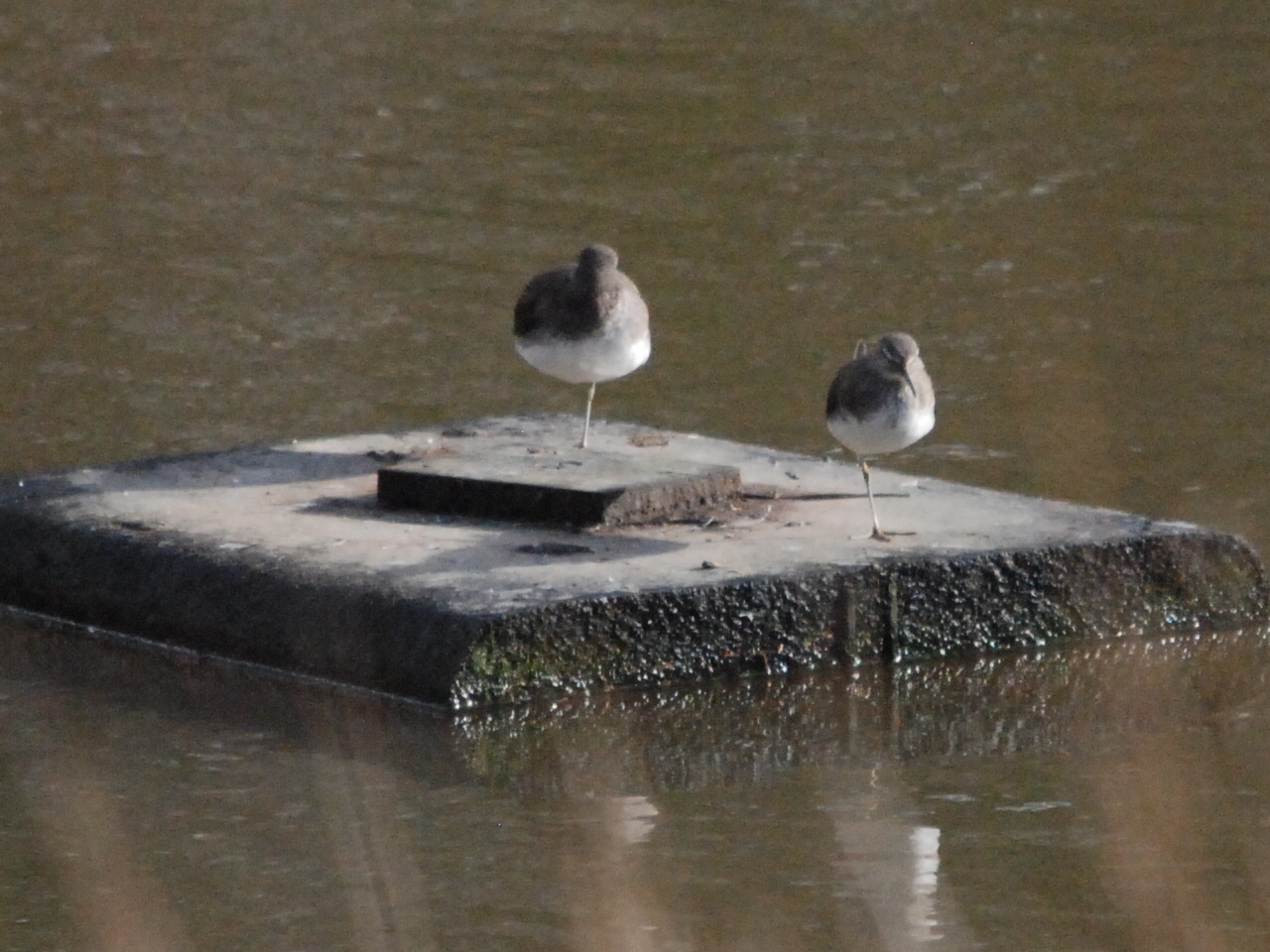
Green Sandpiper is the wader most likely to be encountered in woodland and scrubby habitats usually, but not always, associated with water. At least for the last few years, Sealyham in the Anghof valley has been a regular wintering site for one or two birds which arrive in November and depart in April. The habitat consists of ponds, some of which are very silted up, a stream, gardens and woodland in a river valley. They seem also to use a stream on nearby farmland and maybe a slurry pit there. The photos below are of this winter's birds. There seems to be a male and female, judging by size difference. They are very wary and alert, usually a flash of white and black and a piercing call are all you experience. It's pretty magical around the garden though.


New Heronry

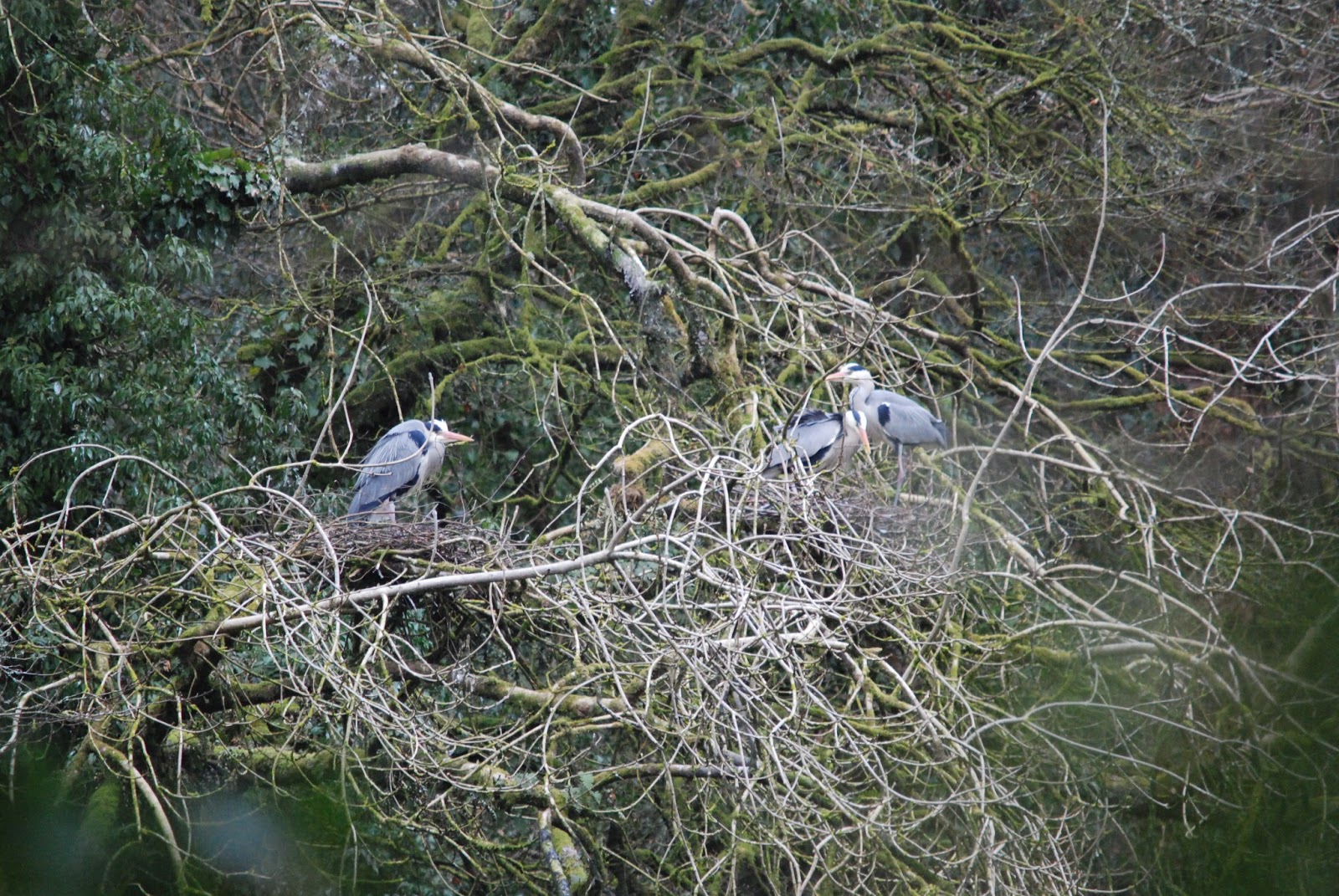
Grey Herons have bred on land we own at least once before. A single nest was noted by Graham Rees in 1986, then containing two young. There were indications of breeding this year with at least two birds seen at  garden ponds in February and early March. Kathy eventually found the birds on two obvious nests with a third half-formed above them. There is a possibility of disturbance, mainly due to business activities but we'll try to minimise problems as best we can. Everyone is being very co-operative. Hopefully I can update this post as the situation progresses.


Unfortunately one of the nests was abandoned in April. There appeared to be three eggs in the remaining nest which had hatched by 10th May. The photo below was taken on 17th May.


Not entirely sure how three became one, whether eggs didn't hatch or disaster struck two chicks but today (29th May) there is only one, well-grown youngster in the nest.


15 December 2012

St Davids Hd Autumn Summary 2012

September

Back from Spain the Autumn started for me on 31st August when 55 Barnacle Geese flew over and around Ramsey before returning to Cardigan Island from where they presumably originated. On the 5th and 6th Grey Wagtails went through (5 & 3+), the best numbers of a good Autumn. White Wagtails were present early in the month, mainly on the Golf Course, but in low numbers. The first Pied Flycatcher appeared at the Youth Hostel on 7th. On 13th a Long-eared Owl was roosting in the withies in Porthmelgan Valley, a rare bird these days with no known winter roosts. After a break on Skokholm, a walk around on 22nd turned up a Firecrest at The Youth Hostel while the next day, a flushed Grasshopper caused a missed heartbeat or two. An unremarkable September, the weather really wasn't helping!

Long-eared Owl  13th September

October

Just a couple of days birding on the 4th and 5th produced 4 Light-bellied Brents on 4th and Grey Wagtails both days: then it was off to Scilly for a couple of weeks. Arrived back to some vis mig which was nice, mainly Chaffinches with fewer Skylarks and Redwings as well as a Brambling in with the Chaffinches. A Woodcock at the Burial Chamber was good. The Bests' Scaup was still at Penberi Res, remaining on and off through the rest of the Autumn. BD had a Snow Bunting out at the Fort the next day when I had a possible Irish 'hibernicus' Coal Tit at the Youth Hostel, looking very like birds I had seen on St Agnes a little while before. The 23rd was rather quiet but brightened by a Yellow-browed Warbler in the Porthmelgan Withies and a Willow Warbler looking good for 'acredula' along The Pencarnan Track. Another Yellow-browed Warbler was in willows along The Cabin Track the next day and there were 1st yr male and female Ring Ouzels out in the Porthmelgan Withies but, unfortunately, no sign of yesterday's Yellow-browed there. The Ring Ouzels were present on the 25th when 700 Chaffinches went over along with 4+ Bramblings and a selection of other regular migrants. A Black Redstart, oddly keeping to the sycamores at the Youth Hostel, was the first of the Autumn. The 26th was notable for a Jack Snipe found by MH, the first site record for me, and 2 Short-eared Owls with a newly-in 1st w male Ring Ouzel up on the Western Rocks as well as 'abietinus' Chiffchaffs in the Porthmelgan Withies and later at Porth Clais. Another was at the Youth Hostel on the 28th. The first Merlin appeared on 27th, no doubt the first of many sightings till late Spring.


Ring Ouzel   Oct 26th 

October finished for me on 30th with some movement apparent including 3 Bramblings over and a close-in Great Northern in Whitesands Bay.

November

Maybe 1200 Golden Plovers and 600 Lapwings were back around the fields at nearby Crug Glas on 2nd though proving impossible to pin down this year. A Short-eared Owl, at the Burial Chamber, a Woodcock in the Porthmelgan Withies and a new Black Redstart at the Youth Hostel were good but pretty much the sum of the day on the 3rd. The first big arrival of Thrushes occurred on 4th and a couple of Bramblings with the Chaffinches. There were two Bewick's Swans on Penberi briefly, found by LL. Again Thrushes were around in numbers on 6th, especially Blackbirds and Song Thrushes. Another Black Redstart was around on 8th when a Snow Bunting went over. A Short-eared Owl was present next day, a good autumn for them. Again Thrushes were in evidence on 14th, a lively day when 2 Crossbills went over as well as 3+ Bramblings and another Short-eared Owl was present.There were Bramblings again on the 15th and 2 Stock Doves, on 16th, these being very unusual migrants here. An adult male Merlin also started a prolonged stay on this date.
A Black Redstart on 5th December (the 10th of the year)  brought a slightly disappointing autumn to a close.